http://www.sciencedaily.com/releases/2014/02/140225101137.htm
Scientists from Wits University performed research that "debunked two big myths around climate change". First, the number of tropical storms is not increasing like many people have assumed. Rather, they are shifting and the place that will experience the effects of this shift the most is South Africa, especially by 2050 according to the research of Jennifer Fitchett, a PhD student in the Wits School of Geography, Archaeology and Environmental Science (GAES). "We never expected them to move", Fitchett admits of the tropical storms. But that is in fact what's been going on. Instead of an increase in number, we simply have had an increase in accurate technology and therefore automatically have detected more storms than in the past.
Another myth concerned frost. The scientists state, "while global warming is causing frost to be less severe, late season frost is not receding as quickly as flowering is advancing, resulting in increased frost risk which will likely begin to threaten food security". The best example of this is in Kerman, Iran, where "global warming is causing the fruit trees to flower as much as a month earlier than 50 years ago, which is a very rapid shift, changes in last season frost are not happening nearly as quickly". There is a lot of controversy around both of these issues, and more research is to be continuously conducted.
Thursday, February 27, 2014
Microbes on floating ocean plastics: Uncovering the secret world of the Platisphere
http://www.sciencedaily.com/releases/2014/02/140224171658.htm
It has just been discovered that there are "microbes living on floating pieces of plastic marine debris" that can affect the ocean ecosystem big time. Scientists have called this the "Platisphere-an ecological community of microbial organisms living on ocean plastic". With more than a thousand different species, the organisms located in this environment can act as huge threats to other marine animals. According to Tracy Miner who is an associate scientists at Woods Hole Oceanographic Institution in Woods Hole, Massachusettes, "bacteria could acquire additional nutrients as they pass through the guts of the fish", only helping it thrive more and continue living in the Plastisphere. Researchers are emphasizing how important it is that we "reduce the impact of plastic pollution" and that "plastics manufacturers learn how to make their products so they degrade at an optimal rate". Studies are still being conducted as far as "how the plastic is colonized and how it interacts with other marine organisms". The fact that there has been so much pollution that scientists needed to come up with a name for the new ecosystem of plastic is ridiculous.
Portable hydrogen fuel cell unit to provide green, sustainable power to Honolulu port
http://www.sciencedaily.com/releases/2014/02/140225100939.htmhttp://www.sciencedaily.com/releases/2014/02/140225100939.htm
Scientists and engineers are currently working on a technology of "auxiliary power to docked or anchored ships" of clean hydrogen power that will hopefully "lower emissions and reduce energy consumption". It will start initially at the Port of Honolulu and is expected to kick into action in 2015. The main researchers on this project are from Sandia National Laboratories and feel confident that this "portable, self-contained hydrogen fuel cell" will help ports meet their goals of becoming more sustainable and less of an issue for the environment. After the Honolulu Port tries out this technology, the team of scientists will "analyze the project's success and challenges, including the operating and cost parameters needed to make a business case at other ports", hoping to eventually expand into a commercial product.
Sunday, January 26, 2014
Los Angeles would experience stronger-than-expected ground motion in major earthquake, virtual earthquake generator shows
http://www.sciencedaily.com/releases/2014/01/140123141949.htm
Marine Denolle has a PhD in geophysics and is currently leading a group of scientists that are using the "weak vibrations generated by Earth's oceans to produce virtual earthquakes that can be used to predict the ground movement and shaking hazard to buildings form real quakes". As technology is making its way more and more into the science world, some very cool studies are being done worldwide. This group from Stanford realize that "earthquakes aren't the only sources of seismic waves" and are taking advantage of this knowledge to help predict the severity of future earthquakes near fault lines like the major one in California, the San Andreas Fault. The way this works is the scientists use seismographs to pick up "ambient waves" that at first seemed to just interfere when trying to measure real earthquakes, but now allows them to "isolate certain waves" through "mathematical techniques". More specifically, "by studying how the ambient waves moved underground, the researchers were able to predict the actions of much stronger waves from powerful sources", coming to the conclusion that any earthquake in the Lost Angeles area any times soon would be strong and large, with a magnitude of at least 7.0 or greater. What I found most interesting was, thanks to the relatively inexpensive way of making this machine, "it could also be useful for forecasting ground motion in developing countries...you don't kneed large supercomputers to run the simulations". That's really taking advantage of technology and spreading our knowledge the way we should be.
The scent of cancer: Detecting cancer with fruit fly's antenna
http://www.sciencedaily.com/releases/2014/01/140124082702.htm
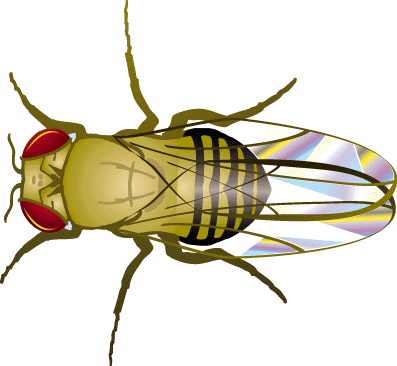
Professor Giovanni Galizia is a neurobiologist and zoologist who is leading research on fruit flies' ability to "distinguish cancer cells from healthy cells via their olfactory sense". An international project, the main studies are being conducted at the University of Konstanz and the University La Sapienza in Rome, Italy. Not only are scientists finding that fruit flies are able to separate cancer cells from healthy cells, but they are able to distinguish which kind of cancer cell they are smelling. Experiments have been performed using dogs as test subjects before the scientists will feel confident enough to try it out with people. In their studies, scientists have found that "five different types of breast cancer cell lines were analyzed" by the fruit flies. The importance of the fruit flies identifying these cancerous subgroups is this: "The high sensitivity of the natural olfactory receptors, paired with the quickness with which [scientists] can generate these test results, might lead to the development of a cheap, fast and highly-efficient pre-screeing that can detect cancer cells well before we can discover them with the present diagnostic imaging techniques". Science is always evolving and findings like this are crucial to our future in the medical world.
Rainforests in Far East shaped by humans for the last 11,000 years
http://www.sciencedaily.com/releases/2014/01/140124082608.htm
Although it has been inferred in the past that "the rain forests of Borneo, Sumatra, Java, Thailand and Vietnam" were "largely unaffected by humans", there has been recent evidence suggesting otherwise. Dr. Chris Hunt is Director of Research on Environmental Change at Queen's School of Geography, Archaeology and Palaeoecology and his findings support the thought that humans in fact have played a huge role in effecting these forests for the last 11,000 years through "repeated disturbance of vegetation since the end of the last ice age". His research is going to be published in the Journal of Archaeological Science and explains his findings of pollen samples that unlock "historical secrets", that we have actually been disturbing these vegetations for years. He notes that there is no correlation to climate change as an excuse for the destruction of these forests, but rather the indigenous people are to blame. It is ambiguous, however, how harmful or helpful human interaction is to forests, as there is evident that the same people who cut down a forest "planted sources of food in its place". It seems to me there will always be a blurred line between helpful and harmful when it comes to humans' interactions with nature.
Mars could have supported life: Ten years on Mars leads to livable mud
http://www.sciencedaily.com/releases/2014/01/140124093710.htm
Scientists from Cornell University have been analyzing old minerals found on Mars and recently found evidence that "around four billion years ago Mars had liquid water so fresh it could have supported life". Professor Steven Squyres led the research and confirmed the likeliness that Mars may "have been habitable". Although the temperature on Mars now is so low that there is no way life could form there, the rock analysis proves that there may have in fact been life there once upon a time, although the mud was "as acidic as vinegar". A major source of the gathered information on Mar was taken by "Opportunity Rover, a golf buggy-sized terrain vehicle" whose 10th anniversary was just celebrated this year. Thanks to Oppy we now have a "richer knowledge" of Mars and know "where to focus our future search", with plenty more to learn!
Subscribe to:
Posts (Atom)